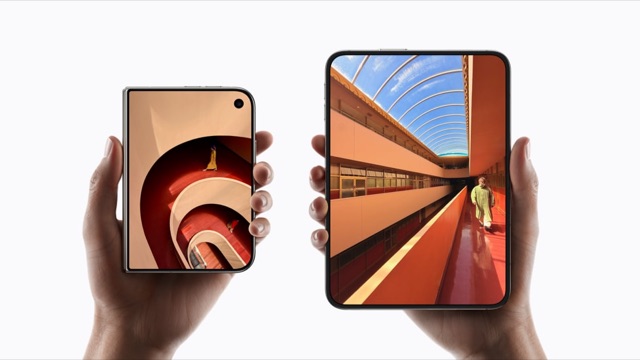
This page collects the published technical specifications of the iPhone Duo, Apple's first foldable iPhone, as listed on Apple's specification sheet and product page.[1][2] Figures that Apple has not published are marked as such. Prices are on the price by country page, and a shorter summary appears in the main article.
|
Inner display (open) |
Outer display (closed) |
| Diagonal (marketing) |
7.6 in |
5.4 in |
| Diagonal (as a rectangle) |
7.58 in |
5.36 in |
| Panel |
Super Retina XDR foldable OLED |
Super Retina XDR OLED |
| Resolution |
2670 × 1878 px, 430 ppi |
2034 × 1398 px, 460 ppi |
| Refresh rate |
ProMotion, adaptive up to 120 Hz |
| Always-On display |
Yes |
Yes |
| Peak outdoor brightness |
3000 nits |
3000 nits |
| Surface |
Nano-texture matte finish |
Ceramic Shield 2 |
| Front camera |
Under-display FaceTime camera |
12 MP Center Stage camera |
All display figures are from Apple's specification sheet.[1] Apple states that both panels share one aspect ratio, that the inner display is about 50 percent larger than the iPhone 18 Pro Max display, and that the outer display has roughly 90 percent of the screen area of the iPhone 18 Pro.[2] The inner cover is a stack of ten thin layers, including a custom polymer that Apple describes as 40 percent stiffer than the industry norm, a scratch-resistant coating over glass, and a titanium plate.[2] UNKNOWN Apple has not published a crease depth or width.[1]
| Component |
Specification |
| System on a chip |
Apple A20 Pro, 2 nm process[3] |
| CPU |
6-core (2 performance, 4 efficiency); Apple claims up to 20 percent faster than A19 Pro[1][2] |
| GPU |
7-core; Apple claims up to 40 percent faster than A19 Pro[2] |
| Neural Engine |
Dual 16-core; Apple claims twice the on-device AI compute[2] |
| Memory bandwidth |
Apple claims 50 percent higher than A19 Pro[2] |
| Thermal design |
Chip package bonded to a custom vapour chamber; Apple claims up to 35 percent better sustained performance than iPhone 17 Pro[2] |
| RAM |
UNVERIFIED Not published by Apple; third-party databases list 12 GB[4][5] |
| Storage |
256 GB, 512 GB, 1 TB, 2 TB[1] |
Body and durability
[edit]
| Attribute |
Specification |
| Form factor |
Book-style fold, opens like a passport[3] |
| Closed dimensions |
117.8 mm (H) × 84.1 mm (W) × 11.3 mm (D)[1] |
| Open dimensions |
117.8 mm (H) × 164.6 mm (W) × 5.2 mm (D)[1] |
| Weight |
254 g[1] |
| Frame |
Grade 5 titanium, mirror-polished[3][6] |
| Hinge cover |
3D-printed 100 percent recycled titanium, micro-blasted finish[3] |
| Hinge |
More than 100 components; supports display centre; magnet array for closure; holds intermediate angles[3][2] |
| Back |
Ceramic Shield[3] |
| Outer display cover |
Ceramic Shield 2[3] |
| Water and dust resistance |
IP68, 6 m for up to 30 minutes[1] |
| Colours |
Star White, Night Sky[3] |
| Buttons |
Side button with Touch ID; Camera Control; volume buttons (reported on the top edge)[1][6] |
| Camera |
Specification |
| Fusion Main |
48 MP, 26 mm equivalent, ƒ/1.6, sensor-shift OIS, Hybrid Focus Pixels; 24 MP default output, 48 MP full resolution[1] |
| Fusion Ultra Wide |
48 MP, 13 mm equivalent, ƒ/2.2, 120° field of view, macro[1] |
| Telephoto |
None. 12 MP optical-quality 2× crop from the main camera (52 mm)[1] |
| Zoom range |
4× optical-quality range (0.5× to 2×); digital zoom up to 10×[1] |
| Front (outer display) |
12 MP Center Stage camera with automatic framing[1] |
| Front (inner display) |
Under-display FaceTime camera[1] |
| Video |
4K Dolby Vision at up to 120 fps on the main camera; cinematic effects applied after capture; 4K Dolby Vision HDR time-lapse; Audio Mix[1][2] |
| Fold-specific features |
Smart Take, Duo Preview, rear-camera selfies with outer-display preview, Kid Cue, Duo FaceTime, Dual Capture, Siri camera mode[3][2] |
Battery and charging
[edit]
| Attribute |
Specification |
| Architecture |
Two cells, one per half, with energy rebalancing[2] |
| Capacity |
UNKNOWN Not published by Apple[1] |
| Video playback |
Up to 31 hours (inner display); up to 44 hours (outer display)[1] |
| Mixed use |
About 24 hours with both displays used equally[3] |
| Wired charging |
Up to 50 percent in about 20 minutes with a 60 W or higher USB-C adapter[1] |
| Wireless charging |
MagSafe and Qi2 at up to 25 W; up to 50 percent in about 30 minutes[1] |
| Materials |
100 percent recycled cobalt[2] |
Connectivity and security
[edit]
| Attribute |
Specification |
| SIM |
eSIM only, in every market[1] |
| Cellular |
Apple C2 modem; 5G with mmWave in the United States[1][2] |
| Wireless |
Apple N1: Wi-Fi 7, Bluetooth 6, Thread[1] |
| Satellite |
Supported[1] |
| Port |
USB-C[1] |
| Biometrics |
Touch ID in the side button; Apple Watch unlock; no Face ID[1][2] |
| Number transfer |
iPhone Handoff (iOS 27), launch carriers T-Mobile (US) and Telekom (Germany)[3] |
iPhone Duo ships with iOS 27.1 and supports Split View, side-mounted controls, StandBy on either display, Apple Intelligence and the Siri AI beta.[3][2] Apple Pencil (USB-C) support for both displays is planned for a software update later in 2026.[3]
Apple lists the phone and a 1-metre USB-C charging cable.[1]
Apple states 35 percent recycled content by weight, 100 percent recycled cobalt in the battery and titanium in the hinge cover, 60 percent renewable electricity in manufacturing, and 100 percent fibre-based packaging.[2]